

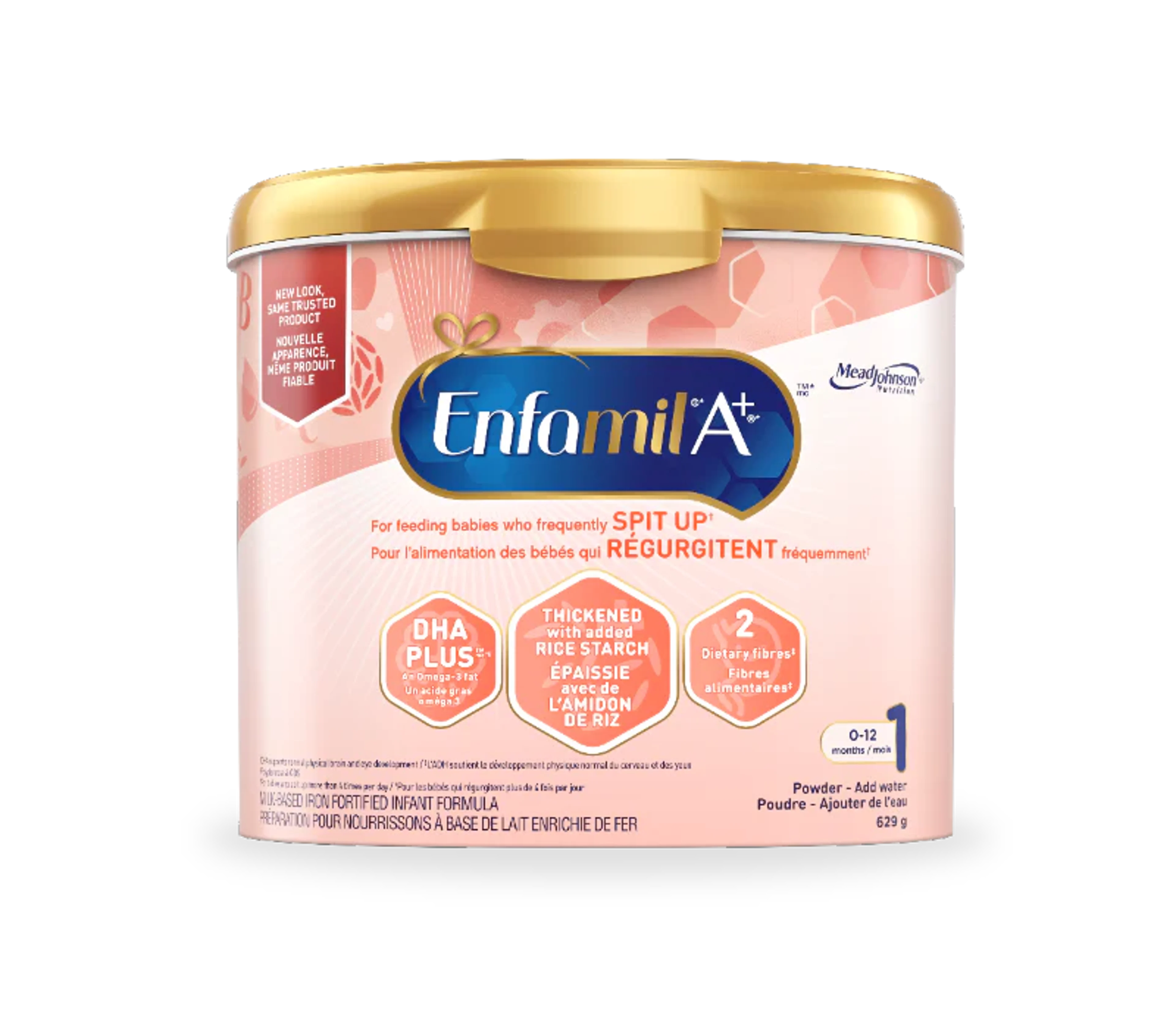
Enfamil A+® For feeding babies who frequently Spit Up†
Cow’s milk-based, iron fortified infant formula with added rice starch for infants who spit up frequently or who otherwise need a thickened formula.
†For babies who spit up more than 4 times per day.
ⓊD M IFANCA®
Cow’s milk-based, iron fortified infant formula with added rice starch for infants who spit up frequently or who otherwise need a thickened formula. Contains two dietary fibres (galactooligosaccharides and polydextrose) and DHA (a type of Omega-3 fat).
| Product | Format | Unit Size | Approximate Product Yield at Normal Dilution | Shelf Life | Item Number | Availability |
|---|---|---|---|---|---|---|
| Enfamil A+® For feeding babies who frequently Spit Up† | Powder | 629 g | 5000 mL (21 bottles x 8 fl oz) | 18 Months | 3271466 | Hospital, Retail, Online |
‡ For babies who spit up more than 4 times per day.
| Item Number | Product Name | Halal Status | Kosher Status |
|---|---|---|---|
| 3271466 | Enfamil A+® For feeding babies who frequently Spit Up† | Halal Certified | Kosher Dairy |
Milk ingredients, Contains three or more of the following (palm olein oil, coconut oil, soy oil, high oleic sunflower oil), Rice starch, Lactose, Maltodextrin, Polydextrose, Galactooligosaccharide solids (GOS),Mortierella alpina oil*, Corn syrup solids, Crypthecodinium cohnii oil+, Taurine, L-carnitine, Ascorbyl palmitate, Mixed tocopherols, (may contain potassium hydroxide), Minerals (calcium carbonate, calcium phosphate, cupric sulfate, ferrous sulfate, manganese sulfate, potassium iodide, sodium citrate, sodium selenite and zinc sulfate), Vitamins (ascorbic acid, biotin, calcium D-pantothenate, choline chloride, dl-α-tocopheryl acetate, folic acid, inositol, niacinamide, pyridoxine hydrochloride, riboflavin, thiamine hydrochloride, vitamin A palmitate, vitamin B12, vitamin D3 and vitamin K1).
* A source of ARA.
† A source of DHA.
| Analysis | per 100 mL (normal dilution) | per 100 g |
|---|---|---|
| Energy (kcal/kJ) | 68/280 | 500/2090 |
| Protein (g) | 1.7 | 12 |
| % of total energy | 10 | 10 |
| Source: Nonfat milk | ||
| Carbohydrate (g) | 7.6 | 56 |
| % of total energy | 44 | 44 |
| Galactooligosaccharides (g) | 0.2 | 1.5 |
| Polydextrose (g) | 0.2 | 1.5 |
| Source: Lactose, rice starch, maltodextrin, galactooligosaccharides, polydextrose | ||
| Fat (g) | 3.4 | 25 |
| % of total energy | 46 | 46 |
| Source: Palm olein (44%), soy (19.5%), coconut (19.5%), high oleic sunflower (14.5%) oils, ARA & DHA single cell oil blend (2.5%) | ||
| Linoleic Acid (g) | 0.5 | 3.9 |
| Linolenic Acid (g) | 0.05 | 0.35 |
| ARA (mg) | 23 | 169 |
| DHA (mg) | 11 | 85 |
| Minerals | ||
| Calcium (mg) | 53 | 390 |
| Phosphorus (mg) | 36 | 260 |
| Magnesium (mg) | 5.4 | 40 |
| Iron (mg) | 1.22 | 9 |
| Zinc (mg) | 0.68 | 5 |
| Manganese (mg) | 0.0101 | 0.075 |
| Copper (mg) | 0.051 | 0.37 |
| Iodine (mg) | 0.0101 | 0.075 |
| Selenium (mg) | 0.00189 | 0.0139 |
| Sodium (mg) | 27 | 200 |
| Potassium (mg) | 73 | 540 |
| Chloride (mg) | 51 | 370 |
| Vitamins | ||
| Vitamin A (IU) | 200 | 1490 |
| Vitamin D (IU) | 41 | 300 |
| Vitamin E (IU) | 1.35 | 9.9 |
| Vitamin K (mg) | 0.0061 | 0.045 |
| Vitamin C (mg) | 8.1 | 60 |
| Thiamine (mg) | 0.054 | 0.4 |
| Riboflavin (mg) | 0.095 | 0.7 |
| Niacin (mg) | 0.68 | 5 |
| Pantothenic Acid (mg) | 0.34 | 2.5 |
| Vitamin B6 (mg) | 0.041 | 0.3 |
| Folic Acid (mg) | 0.0108 | 0.08 |
| Vitamin B12 (mg) | 0.0002 | 0.00149 |
| Biotin (mg) | 0.002 | 0.0149 |
| Choline (mg) | 16.2 | 119 |
| Inositol (mg) | 4.1 | 30 |
| Carnitine (mg) | 1.35 | 9.9 |
| Taurine (mg) | 4.1 | 30 |
| Other Characteristics | |
|---|---|
| Potential Renal Solute Load (mOsm/100 mL)1 | 15.3 |
| Osmolality (mOsm/kg H2O) | 230 |
| Osmolarity (mOsm/L) | 210 |
| Water (g/100 mL) | 90 |
Powdered formulas are not sterile. “To minimize the risk of infection, powdered formulas are not recommended for use in premature or immunocompromised infants unless no appropriate nutritional alternative is available, and then only with strict medical supervision and careful preparation, storage and use.”2.
1. Fomon SJ, Ziegler EE. Renal solute load and potential renal solute load in infancy. J Pediatr. 1999; 134:11-14. 2. International Formula Council. Infant Feeding: Safety Issues for Health Care Professionals. Atlanta, GA: International Formula Council; 2004:4.
Nutrient values are subject to change. Consult actual product labels for most current information.
Powder
Your baby's health depends on carefully following the instructions below. Proper hygiene, preparation, dilution, use, and storage are important when preparing infant formula. Powdered infant formulas are not sterile and should not be fed to premature infants or infants who might have immune problems unless directed and supervised by your baby's doctor. Ask your baby’s doctor which formula is appropriate for your baby.
Carefully follow preparation instructions on the label. LET BOTTLE SIT FOR 5 MINUTES PRIOR TO FEEDING.

1
Wash hands thoroughly with soap and water before preparing formula. Boil clean bottles, nipples, caps and utensils in water (2 minutes at a rolling boil).

2
Boil fresh water at a rolling boil for 2 minutes. Cool to room temperature prior to mixing.

3
Pour desired amount of the cooled water into the bottle. Add powder. Cap bottle and SHAKE WELL. LET BOTTLE SIT 5 MINUTES.
Use the chart below for the correct amounts of cooled, boiled water and powder. Use scoop in tub to measure powder. Store DRY scoop in this tub.
| To Make | Boiled Water | Powder |
|---|---|---|
| 60 mL bottle | 60 mL (1/4 cup) | 1 unpacked level scoop |
| 120 mL bottle | 120 mL (1/2 cup) | 2 unpacked level scoops |
| 180 mL bottle | 180 mL (3/4 cup) | 3 unpacked level scoops |
| 240 mL bottle | 240 mL (1 cup) | 4 unpacked level scoops |
WARNING: Do not use a microwave oven to warm formula. Serious burns may result.
Failure to follow these instructions could result in severe harm. Once prepared, infant formula can spoil quickly. Either feed immediately or cover and store in refrigerator at 2-4°C (35-40°F) for no longer than 24 hours. Do not use prepared formula if it is unrefrigerated for more than a total of 2 hours. Do not freeze prepared formula. After feeding begins, use formula within one hour or discard.
Storage/Handling: Store powder at room temperature; avoid extreme temperatures. After opening and between uses, keep pouch and tub lid tightly closed, store in a dry area, and use contents within 1 month. Do not store loose powder in tub. Use tub with Enfamil A+ For feeding babies who frequently Spit Up formula only. Keep powder fresh and prevent bacterial growth by ensuring tub is clean and completely dry. Completely empty tub and wipe with a clean, dry cloth before reusing. Each pouch has a new batch code and expiration date sticker that must be retained until the contents of the pouch have been consumed.
N/A