

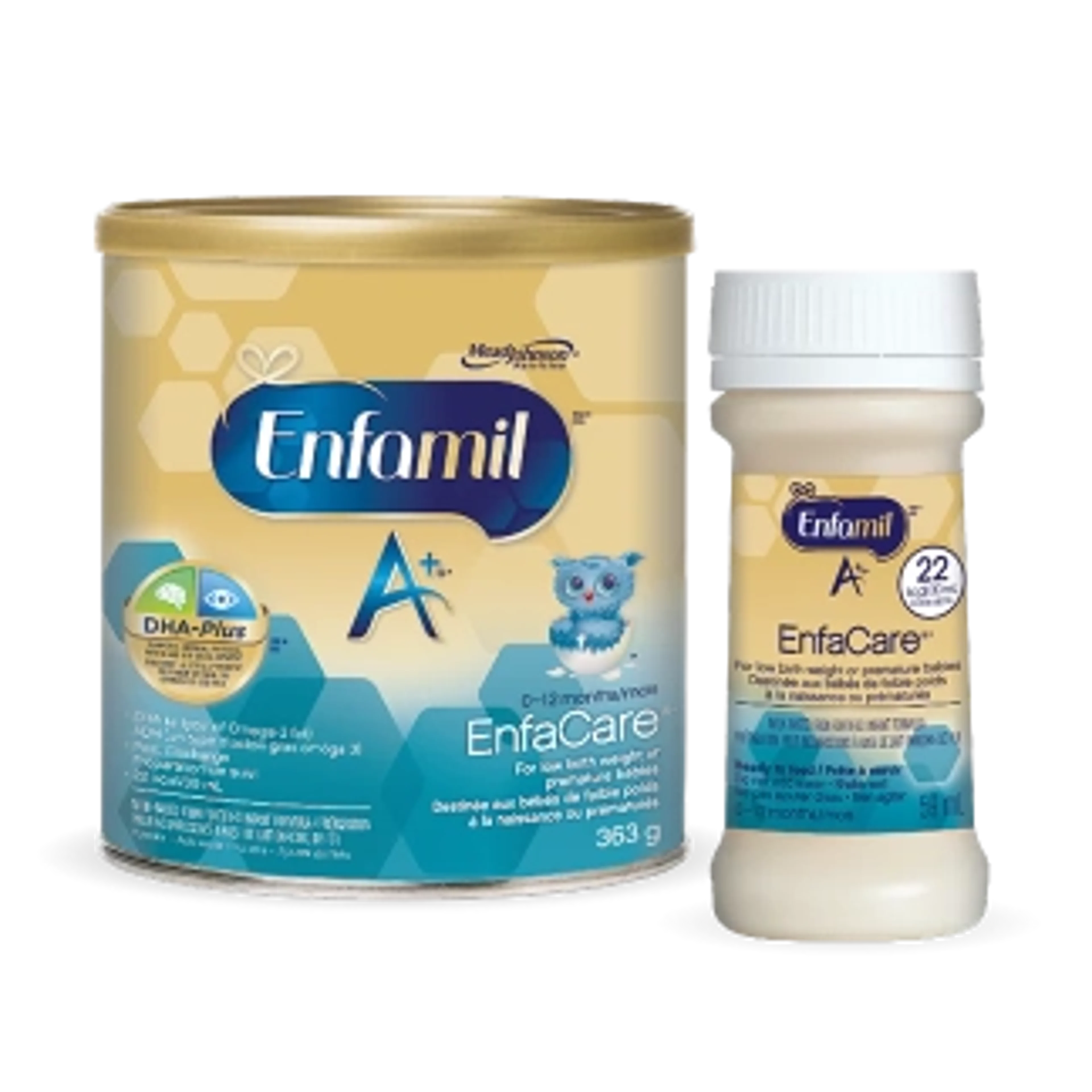
Enfamil A+® EnfaCare®
Préparation à base de lait de vache et enrichie de fer pour les nourrissons prématurés ou de faible poids à la naissance qui sortent de l’hôpital.
ⓊD M IFANCA
Préparation à base de lait de vache et enrichie de fer pour les nourrissons prématurés ou de faible poids à la naissance qui sortent de l’hôpital. Contient de l’ADH (un type d’acide gras oméga 3).
| Produit | Format | Unité | Quantité approximative de produit apprêtée obtenue à la dilution normale | Durée de conservation | N° d’article |
|---|---|---|---|---|---|
| Enfamil A+® EnfaCare® | Poudre | 363 g | 2400 mL (13,5 bottles x 6 oz liq) | 18 mois | 1171320 |
| Biberon Nursette® | 59 m | 59 mL (2 oz liq) | 12 mois | 1215387 |
POUDRE
Substances laitières modifiées, extraits secs de sirop de maïs, lactose, huile végétale à forte teneur en acide oléique (huile de tournesol et/ou huile de carthame), huile de soya, triglycérides à chaîne moyenne (huile de noix de coco fractionnée), huile de noix de coco, huile de Mortierella alpina†, huile de Crypthecodinium cohnii*, maltodextrine, taurine, nucléotides (adénosine-5’-monophosphate, cytidine-5’-monophosphate, guanosine-5’-monophosphate disodique, uridine-5’-monophosphate disodique), L-carnitine, palmitate d’ascorbyle, mélange de tocophérols, (peut contenir de l’hydroxyde de potassium), minéraux (carbonate de calcium, chlorure de magnésium, chlorure de sodium, citrate de potassium, iodure de potassium, phosphate de calcium, sélénite de sodium, sulfate de cuivre, sulfate de manganèse, sulfate de zinc et sulfate ferreux), vitamines (acétate de dl-α-tocophéryle, acide ascorbique, acide folique, biotine, chlorhydrate de pyridoxine, chlorhydrate de thiamine, chlorure de choline, d-pantothénate de calcium, inositol, niacinamide, palmitate de vitamine A, riboflavine, vitamine B12, vitamine D3 et vitamine K1).
* Source d’ADH.
† Source d'ARA.
BIBERON NURSETTE® 59 mL
Eau, maltodextrine, substances laitières modifiées, lactose, huile végétale riche en acide oléique (huile de tournesol et/ou huile de carthame, huile de soya, triglycérides à chaîne moyenne (huile de noix de coco fractionnée), huile de noix de coco, mono- et diglycérides, huile de Mortierella alpina†, lécithine de soya, huile de Crypthecodinium cohnii*, carraghénine, extraits secs de sirop de maïs, taurine, nucléotides (adénosine-5’-monophosphate, cytidine-5’-monophosphate, guanosine-5’-monophosphate disodique, uridine-5’-monophosphate disodique), L-carnitine, palmitate d’ascorbyle, mélange de tocophérols, (peut contenir de l’hydroxyde de potassium), Minéraux (chlorure de calcium, chlorure de magnésium, citrate de calcium, citrate de potassium, citrate de sodium, iodure de potassium, phosphate de calcium, phosphate de magnésium, sélénite de sodium, sulfate de cuivre, sulfate de manganèse, sulfate de zinc et sulfate ferreux), Vitamines (acétate de dl-α-tocophéryle, acide ascorbique, acide folique, ascorbate de sodium, biotine, chlorhydrate de pyridoxine, chlorhydrate de thiamine, chlorure de choline, d-pantothénate de calcium, inositol, niacinamide, palmitate de vitamine A, riboflavine, vitamine B12, vitamine D3 et vitamine K1).
* Source d’ADH.
† Source d'ARA.
| Analyse | par 100 mL (dilution normale) | par 100 g de poudre | par 100 kcal |
|---|---|---|---|
| Calories (kcal/kJ) | 74/310 | 490/2060 | 100/420 |
| Protéines (g) | 2,1 | 13,8 | 2,8 |
| % du total des calories | 11 | 11 | 11 |
| Source: concentrée de protéines de lactosérum, lait écrémé | |||
| Glucides (g) | 7,7 | 51 | 10,4 |
| % du total des calories | 42 | 42 | 42 |
| Source: lactose, extraits secs de sirop de maïs | |||
| Matières grasses (g) | 3,9 | 26 | 5,3 |
| % du total des calories | 47 | 47 | 47 |
| Source: Huile végétale à forte teneur en acide oléique (34%), huile de soya (29%), huile TCM (20%), huile de noix de coco (14%), ARA et ADH provenant d'un mélange d'huile d'organismes unicellulaires (3%) | |||
| Acide linoléique (g) | 0,64 (poudre) 0,67 (biberon Nursette®) | 4,2 | 0,9 |
| Acide linolénique (g) | 0,07 (poudre) 0,067 (biberon Nursette®) | 0,47 | 0,09 |
| ARA (mg) | 25 | 168 | 34 |
| ADH (mg) | 12,6 | 84 | 17 |
| Minéraux | |||
| Calcium (mg) | 89 | 590 | 120 |
| Calcium (mmol) | 2,2* | - | 3,0 |
| Phosphore (mg) | 49 | 330 | 66 |
| Phosphore (mmol) | 1,58* | - | 2,1 |
| Magnésium (mg) | 5,9 | 39 | 8 |
| Magnésium (mmol) | 1,58* | - | 0,33 |
| Fer (mg) | 1,33 | 8,9 | 1,8 |
| Zinc (mg) | 0,74 | 4,9 | 1 |
| Manganèse (mg) | 0,0111 | 0,074 | 0,015 |
| Cuivre (mg) | 0,067 | 0,59 | 0,12 |
| Iode (mg) | 0,0155 | 0,104 | 0,021 |
| Sélénium (mg) | 0,0021 | 0,0138 | 0,0028 |
| Sodium (mg) | 27 (poudre) 26 (biberon Nursette®) | 182 | 35 |
| Sodium (mmol) | 1,13* | - | 1,52 |
| Potassium (mg) | 78 | 520 | 105 |
| Potassium (mmol) | 2,0* | - | 2,7 |
| Chlorure (mg) | 58 | 380 | 78 |
| Chlorure (mmol) | 1,63* | - | 2,2 |
| Vitamines | |||
| Vitamine A (UI) | 330 | 2200 | 450 |
| Vitamine D (UI) | 56 | 350 | 70 |
| Vitamine E (UI) | 3 | 20 | 4 |
| Vitamine K (mg) | 0,0059 | 0,039 | 0,008 |
| Vitamine C (mg) | 11,8 | 79 | 16 |
| Thiamine (mg) | 0,148 | 0,99 | 0,2 |
| Riboflavine (mg) | 0,148 | 0,99 | 0,2 |
| Niacine (mg) | 0,74 (boudre) 1,48 (biberon Nursette®) | 4,9 | 1 (poudre) 2 (biberon Nursette®)* |
| Acide pantothénique (mg) | 0,63 | 4,2 | 0,85 |
| Vitamine B6 (mg) | 0,044 (poudre) 0,074 (biberon Nursette®)* | 0,3 | 0,06 (poudre) 0,1 (biberon Nursette®)* |
| Acide folique (mg) | 0,0192 | 0,128 | 0,026 |
| Vitamine B12 (mg) | 0,00022 | 0,00148 | 0,0003 |
| Biotine (mg) | 0,0037 (poudre) 0,0044 (biberon Nursette®)* | 0,025 | 0,005 (poudre) 0,006 (biberon Nursette®)* |
| Choline (mg) | 17,8 | 118 | 24 |
| Inositol (mg) | 22 | 148 | 30 |
| Carnitine (mg) | 1,48 | 9,9 | 2 |
| Taurine (mg) | 4,4 | 30 | 6 |
| Nucléotides (mg) | 3,1 | 21 | 4,2 |
| Charge osmotique rénale (mOsm/100 mL)1 | 18,4 (poudre) 18,3 (biberon Nursette®)* |
| Osmolalité (mOsm/kg H2O) | 310 (poudre) 250 (biberon Nursette®)* |
| Osmolarité (mOsm/L) | 280 (poudre) 220 (biberon Nursette®)* |
| Eau (g/100 mL) | 89 |
* Par 100 mL de liquide no dilué.
Poudre
Suivre attentivement le mode d’emploi ci-dessous, car la santé de votre bébé en dépend. Il est important de respecter les normes appropriées en matière d’hydiène, de préparation, de dilution, d’usage et de conservation au moment d’apprêter la préparation pour nourrissons. Les préparations pour nourrissons en poudre ne sont pas stériles et ne doivent pas être administrées à des nourrissons prématurés ou immunodéprimés, sauf indication contraire du médecin de votre bébé et sous sa supervision. Demander au professionnel de la santé de votre bébé quelle est la préparation appropriée dans son cas.

1
Se laver soigneusement les mains avec du savon et de l’eau avant d’apprêter la préparation. Faire bouillir les bouteilles, les tétines, les couvercles et les ustensiles propres dans de l’eau (2 minutes à forte ébullition).

2
Faire bouillir de l’eau fraîche à forte ébullition pour 2 minutes. Laisser refroidir à la température ambiante avant de mélanger.

3
Verser la quantité d’eau refroidie appropriée dans la bouteille. Ajouter la poudre. Visser le couvercle du biberon et BIEN AGITER.
Le tableau ci-dessous indique les quantités d’eau refroidie, d’eau bouillie et de poudre à utiliser. Utiliser la mesure fournie dans la boîte pour mesurer la poudre. Conserver la mesure SÈCHE dans la boîte.
| Pour obtenir | Eau bouillie | Poudre |
|---|---|---|
| Bouteille de 60 mL | 60 mL (1/4 tasse) | 1 mesure rases tassée |
| Bouteille de 120 mL | 120 mL (1/2 tasse) | 2 mesure rases tassées |
| Bouteille de 180 mL | 180 mL (3/4 tasse) | 3 mesures rases tassées |
| Bouteille de 240 mL | 240 mL (1 tasse) | 4 mesur es rases tassées |
MISE EN GARDE: Ne pas réchauffer la préparation au four à micro-ondes. Degraves brûlures peuvent en résulter.
Le non-respect de ces directives pourrait avoir de graves conséquences. Une fois apprêtée, la préparation pour nourrissons peut se gâter rapidement. Servir immédiatement ou couvrir et conserver au réfrigérateur entre 2 et 4 °C (entre 35 et 40 °F) pendant un maximum de 24 heures. Ne pas utiliser la préparation apprêtée si elle est demeurée plus de 2 heures au total sans être réfrigérée. Ne pas congeler la préparation apprêtée. Après le début de la consommation, jeter toute préparation inutilisée après une heure.
Conservation/manipulation : Conserver la poudre à la température ambiante. Couvrir hermétiquement les boîtes ouvertes, les conserver dans un endroit sec et les utiliser dans un délai de 1 mois. Il ne faut pas congeler la poudre ni l’exposer à une chaleur excessive.
Biberon Nursette®
Suivre attentivement le mode d’emploi ci-dessous, car la santé de votre bébé en dépend. Il est important de respecter les normes appropriées en matière d’hygiène, de préparation, d’usage et de conservation au moment d’apprêter la préparation pour nourrissons. Utiliser selon les directives du médecin de votre bébé. Vérifier chaque bouteille pour détecter tout signe de dommage.

1
Se laver soigneusement les mains avec du savon et de l’eau avant de préparer la bouteille à servir.

2
BIEN AGITER LA BOUTEILLE, puis retirer le couvercle.

3
Fixez une TÉTINE JETABLE (non incluse) ou demander au médecin de son bébé s’il est nécessaire de faire bouillir une tétine propre dans l’eau avant l’utilisation.
MISE EN GARDE: Ne pas réchauffer la préparation au four à micro-ondes. De graves brûlures peuvent en résulter.
Le non-respect de ces directives pourrait avoir de graves conséquences. Le contenu des bouteilles ouvertes et apprêtées peut se gâter rapidement. Servir immédiatement ou remettre le couvercle et conserver au réfrigérateur entre 2 et 4 °C (entre 35 et 40 °F) pendant un maximum de 24 heures. Ne pas utiliser la bouteille ouverte ou apprêtée si elle est demeurée plus de 2 heures au total sans être réfrigérée. Ne pas congeler la préparation. Après le début de la consommation, jeter toute préparation inutilisée après une heure.
Conservation: Conserver les bouteilles qui n’ont pas été ouvertes à la température ambiante. Éviter la chaleur excessive et l’exposition prolongée à la lumière. Ne pas congeler.
NE PAS UTILISER SI LA BAGUE DU COUVERCLE EST ENDOMMAGÉE OU ABSENTE.
UTILISER AVANT LA DATE DE PÉREMPTION FIGURANT SUR LA BOÎTE OU LA BOUTEILLE.